Low Key Leaders

Some preachers are the kind of leaders who stride into a room, rally a team, draw a diagram on a whiteboard, and suddenly everyone is ready to charge the hill. Conversely, many ministers quietly wonder, “What hill are we charging, and can we talk about it over coffee instead?” The truth is not every leader is a visionary strategist. Some are teachers. Some are listeners. Some do their best work one conversation at a time. And that’s not a liability; it is a gift.

Paul Merideth

While strong vision-casting teambuilding leaders are a blessing to the church, not everyone can pull it off effectively. Thankfully, Scripture leaves plenty of room for men who lead in a low-key way. Paul tells Timothy to watch his life and teaching closely (1 Timothy 4:16). He tells the Thessalonians to encourage the fainthearted and help the weak (1 Thessalonians 5:14). Peter urges shepherds to lead “by example” rather than force (1 Peter 5:3). These passages sound far less like instructions for a corporate strategist and far more like the quiet, steady work of relational shepherding. Jesus himself shaped most of his leaders around tables, along roads, and in unhurried conversations. His most decisive leadership moments were rarely in committee meetings.

It took me a long time to realize that my gift in ministry was not being a dynamic, consensus-building, trend-setting leader. I could never stride into a room of elders and deacons and unveil a master plan for church goals over the next five years, with everyone walking out hyped up, shouting, “Let’s go!” And though I tried to be that tip-of-the-spear, dynamic, peak-performance, spiritual coach for many years, relief came only when I accepted that I was not that kind of leader. I am a teacher. I am a deliberate, reflective decision maker. I pray with people. I listen to their hurt. I talk to them about Jesus. I even believe slow is an acceptable speed.

And I am thankful God’s Word reminds us that this is enough. We each bring something different to the table. We each, “having gifts that differ according to the grace given to us, let us use them” (Romans 12:6). Paul is not asking us to become gifted in everything, only to steward well what God has actually placed in our hands. That truth frees ministers and elders alike from the pressure of imitation and invites us to simply live out the gifts God has entrusted to us.

When you stop trying to force a round peg into a square hole and accept that your gifts are not about being the grand motivator, you free yourself from pretending. You can stop trying to manufacture energy you do not naturally possess. Instead, you lean into your strengths. Relational leaders influence not through programs but through presence. Their leadership is felt in the way they listen, in the thoughtful questions they ask, and in the gentle guidance they offer when someone is hurting or confused.

This does not mean you abdicate leadership, far from it. It simply means your leadership moves in smaller circles that eventually ripple outward. When you invest in one elder, one ministry leader, or one team member, you help shape a person who will shape others. That is precisely how Jesus worked. The kingdom grows yeast-like, quietly spreading through ordinary interactions that never make an organizational chart but always leave a mark.

You do not have to build an ecclesiastical administrative machine to bless the church. You can bless it by being exactly who God made you to be. A teacher who steadies people. A shepherd who knows the flock by name. A presence that brings peace. A preacher who speaks the truth in love. Leadership is not always loud. Sometimes it sounds like a calm voice saying, “Let’s walk together.” And in the kingdom of God, that is more than enough.


Experiencing Jesus

During the holidays my movie watching skyrockets. I enjoy quality cinema, the kind with rich storytelling and thoughtful technique; think Jurassic Park, not Jurassic World Rebirth. And yes, the theater experience far exceeds the at-home one. My partiality for quality-only films and the theater experience prompts me to reflect on our worship as believers. Christian worship is not meant to be watched from a distance. It is an encounter, an embodied moment that draws us beyond observation into something richer and more transformative. True, genuine-quality worship is rooted in the incarnate Christ who entered our world in flesh and blood so that our whole selves could encounter him in meaningful ways.

Cinematic theory offers surprising parallels. Directors speak of qualia, the felt qualities of an experience that cannot be reduced to simple description. A sunset on screen is more than its colors, and a close-up of a trembling hand is more than pixels. Similarly, worship invites us to experience Christ’s presence. Singing, prayer, communion, and Scripture reading each carry their own spiritual qualia; stirring awe, conviction, gratitude, and hope in ways that surpass explanation. This echoes the psalmist’s invitation: “Taste and see that the Lord is good” (Psalm 34:8), a reminder that our faith engages the whole person.

Filmmakers also note how the eyes can become “an organ of touch,” especially in scenes marked by haptic perceptuality: moments when you don’t simply watch the story but feel it. The textures, nearness, and details create a sense of contact. Worship can work the same way. When we gather in Jesus’ name, we do not only look toward him as spectators. His presence touches us. Lifting our voices or receiving communion becomes a kind of spiritual tactile moment, a place where Christ meets us in real and embodied ways.

Another cinematic idea concerns the use of indexed and non-indexed camera angles. Sometimes the lens points directly at what the viewer must see. Other times it invites discovery through subtle or indirect cues. God uses both approaches. At times, the gospel feels unmistakably indexed: Jesus speaks clearly, Scripture convicts plainly, and we know exactly what he is asking of us. Other moments are quieter and non-indexed: gentle conviction, providential encounters, or unity with the Spirit. These understated moments reveal that Christ continues to guide those who recognize his voice. As Jesus profoundly says, “My sheep hear my voice, and I know them, and they follow me” (John 10:27).

Taken together, these images remind us that worship is an experience rather than a passive event. We think, feel, respond, and participate. We encounter Jesus not as viewers in the seats but as disciples fully engaged in the presence of the living Lord.

Paul N. Merideth


How the Mighty Have Fallen

“The pride of your heart has deceived you… Though you soar aloft like the eagle… from there I will bring you down” (Obadiah 1:3-4). If you ever want a crash course in humility, meet the Edomites. These folks were so sure of themselves they basically built their homes in the sky and said, “Who’s gonna bring us down?” God’s answer was blunt: “I am.” Obadiah, the shortest book in the Old Testament, packs a mighty punch about pride and self-deception. They thought security was measured in stone walls and mountain heights, not in obedience and mercy. The Edomites felt invincible in their mountain stronghold of Petra, that rose-colored city carved into stone, but even walls of rock cannot protect a heart lifted up in pride from inevitable divine judgment. When their neighbors in Judah were attacked, Edom didn’t lend a hand. Instead, they pulled up a chair to watch the show. Thus God declares destructive judgment upon them because not only did they fail to render aid to brethren in distress, but they also kicked them while they were down. Pride had turned them cruel.

Pride still does that. It blinds us, convinces us we’re doing great, and then quietly hardens our hearts until compassion withers. God’s verdict on pride hasn’t changed: “God opposes the proud.” But here’s the good news: He still “gives grace to the humble” (James 4:6).

Obadiah’s lesson is simple… don’t build your house on the high cliffs of ego. Build it on the solid ground of Christ, the humble King. Pride crashes hard, but God always lifts the humble back up.


I am preaching through the Minor Prophets, those short books most folks skip over because they talk a lot about judgment. But here’s the surprise… behind every warning is a divine message about mercy and hope. God still invites His people back even when they have lost their way. Come join us Sundays at 10:30 a.m. at the Northside Church of Christ in Temple, Texas, as we dust off the words of these ancient prophets and discover how much they still have to say to us today.


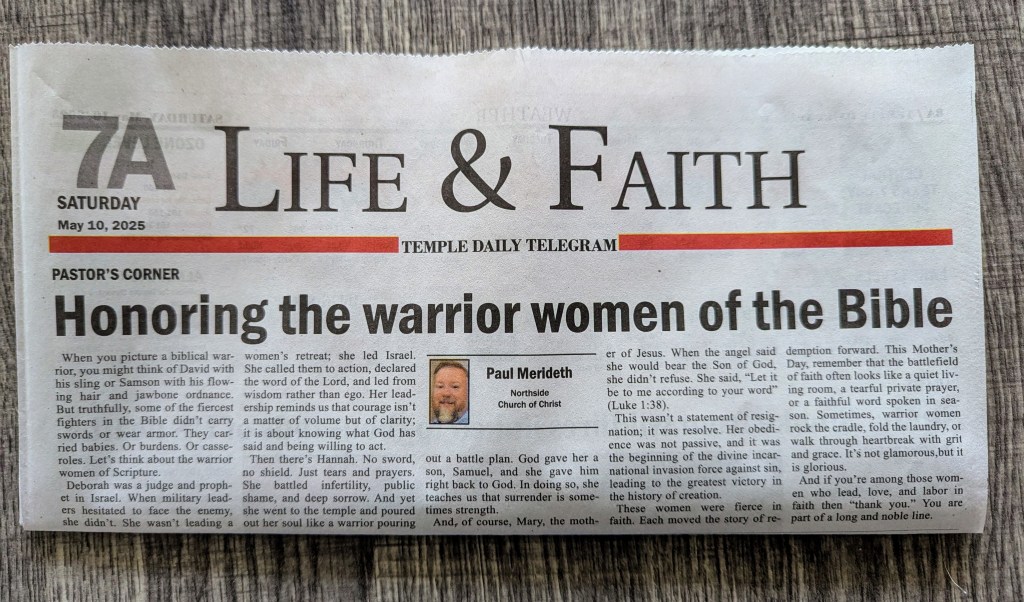
Warrior Women

PAUL MERIDETH

When you picture a biblical warrior, you might think of David with his sling or Samson with his flowing hair and jawbone ordnance. But truthfully, some of the fiercest fighters in the Bible didn’t carry swords or wear armor. They carried babies. Or burdens. Or casseroles. Let’s think about the warrior women of Scripture.

Deborah was a judge and prophet in Israel. When military leaders hesitated to face the enemy, she didn’t. She wasn’t leading a women’s retreat; she led Israel. She called them to action, declared the word of the Lord, and led from wisdom rather than ego. Her leadership reminds us that courage isn’t a matter of volume but of clarity; it is about knowing what God has said and being willing to act.

Then there’s Hannah. No sword, no shield. Just tears and prayers. She battled infertility, public shame, and deep sorrow. And yet she went to the temple and poured out her soul like a warrior pouring out a battle plan. God gave her a son, Samuel, and she gave him right back to God. In doing so, she teaches us that surrender is sometimes strength.

And, of course, Mary, the mother of Jesus. When the angel said she would bear the Son of God, she didn’t refuse. She said, “Let it be to me according to your word” (Luke 1:38). This wasn’t a statement of resignation; it was resolve. Her obedience was not passive, and it was the beginning of the divine incarnational invasion force against sin, leading to the greatest victory in the history of creation.

These women were fierce in faith. Each moved the story of redemption forward. This Mother’s Day, remember that the battlefield of faith often looks like a quiet living room, a tearful private prayer, or a faithful word spoken in season. Sometimes, warrior women rock the cradle, fold the laundry, or walk through heartbreak with grit and grace. It’s not glamorous, but it is glorious.

And if you’re among those women who lead, love, and labor in faith then “thank you.” You are part of a long and noble line.


How’s Your Pulse?

Let’s start with the obvious: if you don’t have a pulse, you’re in trouble. No heartbeat? That’s not just bad news—it’s fatal. So what about the church’s pulse? If we pressed two fingers to her spiritual wrist, would we feel a strong, vibrant beat or a troubling stillness?

Paul Merideth

The church in Corinth, the one Paul wrote to, was showing some signs of spiritual arrhythmia. It was a congregation under siege, pressured by a surrounding pagan culture and infected by internal conflicts and divisions. Satan has always tried to convert the living body of Christ into a lifeless shell. And in Corinth, unfortunately, he was making headway.

But Paul didn’t write them off as spiritually dead. He didn’t rush in with condemnation or a clipboard to pronounce time of death. He opened his letter with something surprisingly hopeful: thanksgiving. That alone tells us the situation wasn’t terminal. There was life still beating in their chest.

He reminded them, “God is faithful, by whom you were called into the fellowship of his Son, Jesus Christ our Lord” (1 Corinthians 1:9).

There it is—the pulse. The steady rhythm that sustains the body of Christ. Faithfulness. Fellowship. These are not abstract theological ideas. They are the vital signs of Christian existence. They are not generated by our effort or enthusiasm but gifted to us by the One who gives life itself. We live because He is faithful. We thrive because we’ve been invited into a living, breathing, grace-filled connection with the Son.

So take a moment. Check your spiritual pulse. Is there a beat of gratitude in you? Can you sense the divine rhythm of grace pulsing through your spirit—God’s mercy, His provision, His redemption, His direction? These are not spiritual luxuries. They are signs of life. If they’re present, you’re alive. If they’re faint or missing, it might be time to consult the Great Physician.

And here’s the beautiful irony: even when our spiritual health falters, God remains steady. His faithfulness is not reactive. It doesn’t rise and fall with our performance. His grace does not ebb when ours does. It flows freely, relentlessly, keeping the body alive even when it stumbles.

Paul continues his note of thanksgiving with a cascade of affirmation:
“I give thanks to my God always for you because of the grace of God that was given you in Christ Jesus…” (1 Corinthians 1:4-8). He goes on to describe how the Corinthians were enriched in every way—speech, knowledge, spiritual gifts—and not just enriched, but confirmed in their faith. They had what they needed to endure. And not only to endure, but to mature.

It’s important to remember that spiritual vitality is not measured by perfection but by direction. Are we moving toward Christ? Are we leaning into grace and growing in love? Is the pulse of our faith stronger today than it was yesterday?

In other words, the church wasn’t dead. She was bruised perhaps, confused at times, even spiritually reckless—but her heart was still beating. And Paul wanted them to hear that heartbeat loud and clear.

And yours is too, if you are in Christ. So take courage. Give thanks. God’s not done with you, and He’s not done with us. You and I are not sustained by sheer willpower. We are sustained by a faithful God who will hold us fast and bring us safely to the finish line.

As Paul says, He will sustain you to the end, guiltless in the day of our Lord Jesus Christ (1 Corinthians 1:8). That is not just a heartbeat. That is a promise. And that promise is pumping life into the church even now.

So again—how’s your pulse?


In Christ

Have you ever tried to board a plane by running really fast beside it? Or maybe by standing underneath it admiring how powerful it looks? Perhaps you think you can make it home from your travels simply by studying the plane’s engineering without ever actually climbing aboard. Sounds ridiculous, right? None of these will get you home. The only way to reach the destination is to be IN the plane. When you’re in the plane, what happens to it happens to you. If it soars, you soar. If it lands safely, you land safely. Yet many people try to admire Jesus from a distance, hoping close proximity alone is enough.

2 Corinthians 5:17 tells us, “If anyone is in Christ, he is a new creation.” The only way to arrive at our eternal home is to be IN Christ. This isn’t just religious jargon—it’s the New Testament’s primary way of describing a Christian. Paul uses the phrase “in Christ” over 160 times. It’s arguably his favorite expression. More than simply admiring Jesus, being in Christ means being fully united with Him, embraced by His grace and transformed by His presence. What happens to Him happens to us. His death becomes our death to sin. His resurrection becomes our resurrection to new life. His standing before God becomes our standing. This is what it means to be in Christ.

So if you’re tired of trying to reach the destination on your own, maybe it’s time to stop running and get in Christ. Through faith, repentance, and baptism, His journey becomes yours and trust me, it’s first class all the way.

Paul Merideth


Current Sermon Series: Throughout the first quarter of 2025, I’m preaching a Sunday series called In Christ. You’re invited to join us each Sunday at 10:30am as we explore what it truly means to live out our identity in Him. Come connect, grow, and walk in the fullness of life in Christ—I’d love to see you there! northsidetemple.org


Book Recommendation: Consider checking out this new book by Sam Allberry from Crossway. As I’ve worked on this lesson series, I’ve found it insightful and encouraging. It explores the life-changing reality of being in Christ.

Equipping the Saints

The desire of a faithful church is to see every member fully equipped to serve in God’s kingdom. In Ephesians 4:11-16, the Apostle Paul provides a compelling picture of what this looks like: a body “joined and held together by every joint with which it is equipped, when each part is working properly, makes the body grow so that it builds itself up in love” (v. 16). This vision is not one of passive participation but of purposeful engagement, where each member contributes to the upbuilding of the whole. A thriving church is alive and active, filled with individuals committed to serving God and one another.

Paul Merideth

David’s encounter with Goliath offers a powerful example of being equipped for God’s work. When he faced the giant, David did not go empty-handed or rely on tools that didn’t suit him. Instead, he used the resources and skills unique to him—a sling, five stones, and an unshakable trust in God. Armed with these, he overcame a seemingly insurmountable challenge. In the same way, God equips every believer with unique talents, tools, and opportunities perfectly suited to their mission.

Scripture reminds us repeatedly that our strength and readiness come from God. The psalmist declares that it is God who equips us with strength (Psalm 18:32), and Paul writes that Scripture makes us “competent, equipped for every good work” (2 Timothy 3:17). These truths empower us to step boldly into the tasks God has prepared, confident that He provides everything we need to succeed.

A church that embraces this vision becomes a place of unity, zeal, and maturity. Unity comes when every resource and talent is dedicated to God’s glory, fostering a sense of shared purpose and collaboration. Zeal is evident when members are eager and enthusiastic about participating in the life and mission of the church. Maturity develops as individuals grow in faith, enabling the church to carry out its ministry with wisdom and effectiveness.

When every member takes up the call to be equipped for service, the church flourishes. It becomes a community that builds itself up in love, deeply engaged in fulfilling God’s mission in the world. This is not merely an aspiration but a call to action. Each believer is urged to pray for God’s guidance and strength, to seek opportunities for growth, and to contribute actively to the life of the church.

The writer of Hebrews offers a fitting prayer: “Now may the God of peace… equip you with everything good that you may do his will, working in us that which is pleasing in his sight” (Hebrews 13:20-21). May this prayer shape and inspire all who seek to be equipped for every good work, faithfully building one another up and carrying out God’s will.


Bible Reading Plan

Reading through the entire Bible in a year can be a challenge for many. Why not try a two-year plan instead? Over 2025 and 2026, journey through the entire Bible at a steady pace. This plan includes readings on weekdays only, leaving weekends open for catching up or deeper study. You can access the reading plan HERE.


This Christmas: Just Believe

I am not a Grinch. I love Christmastime—it’s my favorite season of the year. In fact, I enjoy The Polar Express and its heartwarming message. All those TV holiday specials are great family fun. But I do have a complaint, and it’s about one word we see plastered everywhere this time of year: “Believe.”

You’ve seen it on ornaments, holiday cards, and even glowing in front-yard light displays. BELIEVE! It’s everywhere. Don’t get me wrong; I love the word. But I think we should handle it with a little more care.

Paul Merideth

As a Christian minister, I’m concerned that “believe” has been diluted into a vague sentiment. It’s become a shallow slogan afflicted with the Hallmarkification effect, stripped of its profound meaning and tethered to little more than seasonal cheer. We’ve orphaned the word from its theological context and expect it to carry, all naked and alone, the entire weight of our holiday hopes.

The truth is the word believe carries immense significance in the Christian faith. It is central to who we are as God’s people. And while I don’t begrudge Santa his sleigh, I must insist that “believe” belongs to something infinitely greater. So, I propose we reclaim it and carefully put it back in its nest with the rest of sacred vernacular.

Here’s why this is important. We don’t merely “believe” in an undefined ethereal spirit of winter tidings or a vague sense of holiday magic. No, we believe in God, the Father Almighty, Creator of heaven and earth. We believe in Jesus Christ, His only Son, our Lord—who was conceived by the Holy Spirit, born of the virgin Mary, suffered for our sins at his crucifixion, died, and was buried. On the third day, He rose again. He ascended to heaven and is seated at the Father’s right hand. He will come again to judge the living and the dead. This is what we believe.

“Believe” isn’t just a word to dangle in twinkling lights or print on a mug. It’s not to be etched alone without its divine object clarified. Indeed, the object of our belief is God. It’s a cherished faith conviction that connects us to the God of the universe. Jesus Himself said, “Let not your hearts be troubled. Believe in God; believe also in me” (John 14:1). And Paul reminds us, “If you confess with your mouth that Jesus is Lord and believe in your heart that God raised him from the dead, you will be saved” (Romans 10:9).

This Christmas, let’s reclaim the depth of what it means to believe. As we enjoy the holiday lights and festivities, let’s reflect on the One who gives us hope, joy, and peace—not just for a season, but for eternity. May your Christmas be filled with love, generosity, and the light of Christ. Whether through acts of kindness, a shared smile, or a helping hand, let’s each embody the good news of Jesus this season. I wish you all a Merry Christmas and pray for the Lord’s continued favor upon us all. After all, I believe in our good and gracious God.


This article was published in the Temple Daily Telegram‘s “Life & Faith” section on Saturday, December 21, 2024. Check it out on their website HERE.


Christian Self-Care

In today’s world, “self-care” often evokes images of spa days, digital detoxes, and naps. While Jesus’ ministry was filled with intense demands and self-sacrifice, we see clear examples of how He cared for His own soul in ways that are strikingly relatable. His “self-care” practices included prayer, setting boundaries, and spending time with friends over meals.

First, prayer was central to Jesus’ life. Luke 5:16 notes, “But he would withdraw to desolate places and pray.” Despite the constant needs around Him, Jesus often took time alone with the Father, seeking rest, strength, and guidance. This wasn’t an occasional retreat; it was a regular rhythm in His life.

Jesus also demonstrated the importance of saying “no.” When the disciples urged Him to continue performing miracles in Capernaum, He replied, “I must preach the good news of the kingdom of God to the other towns as well; for I was sent for this purpose” (Luke 4:43). By setting boundaries, He showed that being faithful to His mission sometimes required stepping away from immediate expectations.

Finally, Jesus valued friendship and community, often gathering with His disciples over meals. Whether He was at a wedding in Cana, reclining at the table with Mary and Martha, or sharing the Last Supper, Jesus used these moments to strengthen His relationships and teach His followers. Matthew 11:19 says, “The Son of Man came eating and drinking,” showing His delight in the fellowship of friends.

While Jesus’ life was undoubtedly unique, His practices offer wisdom for us today: seek God in prayer, know your purpose, and cherish meaningful relationships.

Paul Merideth

Christianity and Politics

Navigating the Intersection of Christianity and Politics: A Kingdom Perspective

As Christians, politics can often stir strong emotions and challenge our faith. How do we engage in political life while staying true to our commitment to Christ? The key lies in remembering where our ultimate citizenship is found: not in any earthly nation, but in God’s Kingdom. As Philippians 3:20 reminds us, “Our citizenship is in heaven.” This truth shapes how we should approach politics—recognizing that while earthly governments play a role in society, our first allegiance is always to Jesus and His Kingdom.

Paul Merideth

Christ’s Kingdom transcends all political systems and ideologies. While we live in the world and are affected by its politics, we must remember that no human system can fully bring about the justice, peace, and transformation that only God’s Kingdom can achieve. Jesus Himself acknowledged this when He said, “My kingdom is not of this world” (John 18:36). As followers of Christ, we are called to engage with the world, but our engagement must reflect the values of God’s Kingdom—love, justice, truth, mercy, and humility.

Living as citizens of heaven doesn’t mean withdrawing from political or civic life. Jesus calls us to be the “salt of the earth” and the “light of the world” (Matthew 5:13-16), influencing society by living out God’s truth. In a democracy, voting is a way we exercise our stewardship, reflecting our values in the choices we make. We should vote thoughtfully and prayerfully, aligning our decisions with biblical principles, while avoiding the temptation to place our hope in political leaders or systems. Psalm 146:3 warns us not to “put your trust in princes,” reminding us that ultimate hope lies in Christ alone.

In a divided world, Christians are called to be peacemakers. Political differences can create deep divisions, but our identity in Christ should guide how we treat others, especially those with whom we disagree. We must approach political conversations with humility and grace, promoting understanding and love over hostility and division. Ultimately, our political engagement should reflect our allegiance to Christ, and our actions should point others to the hope found in Him.

To hear my sermon on “Christianity and Politics” from October 6th, 2024, presented at the Northside Church of Christ in Temple, Texas, click HERE.