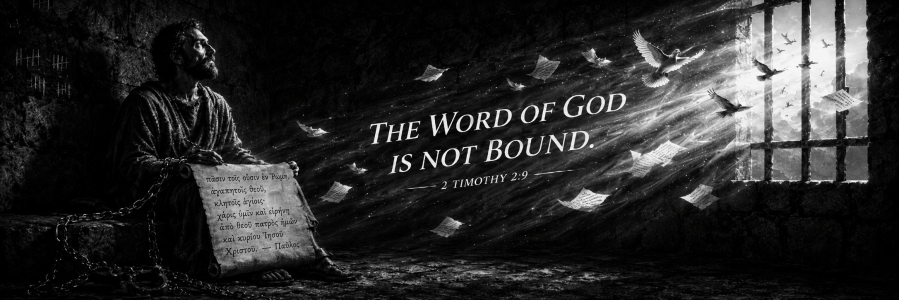
Faith like Paul’s does not deny the chains; it simply believes the gospel is still free.
Paul knew the cold weight of iron, the humiliation of confinement, and the uncertainty of waiting under Roman power. He did not romanticize suffering or pretend that hardship was painless. He felt the chains. He heard the doors lock. Yet from within those limitations, he declared, “I am suffering, bound with chains as a criminal. But the word of God is not bound!” (2 Timothy 2:9).
That is the defiance of Christian faith.
Faith does not require us to call darkness light. It does not ask us to deny the diagnosis, ignore the grief, minimize the opposition, or pretend the prison is not real. Faith looks directly at the chain and then looks beyond it to the sovereign God whom no chain can hold.
Paul’s imprisonment appeared to be the end of his usefulness. Instead, it became another pulpit. Guards heard the gospel. Churches received letters. Believers became bolder. What seemed like restriction became advancement. “What has happened to me,” Paul wrote, “has really served to advance the gospel” (Philippians 1:12).
We often assume God can use us only when circumstances are favorable, doors are open, and burdens are lifted. Paul teaches us otherwise. God may do some of His deepest work through the very limitation we keep asking Him to remove.
Your chains may be real, but they are not sovereign. Your circumstances may restrict your movement, but they cannot imprison God’s purpose. The gospel is still free—and through faithful people, it is still moving.
Hope you all have a safe and blessed Independence Day. As our nation remembers the blessings of liberty, Christians should reflect on a deeper and more enduring freedom: “For freedom Christ has set us free; stand firm therefore, and do not submit again to a yoke of slavery” (Galatians 5:1).
Paul is not describing freedom as autonomy, self-expression, or the absence of obligation. In Galatians, Christian freedom is liberation from the enslaving powers of sin and from the futile attempt to establish righteousness through human effort. Christ frees us from guilt, condemnation, and empty religion, not so that we may live without restraint, but so that we may live in faithful dependence upon God’s grace.
This is why Paul immediately adds, “stand firm.” Freedom in Christ must be received, guarded, and practiced. The believer can drift back into bondage through sinful desire, pride, legalism, or spiritual complacency. Grace is not freedom from faithfulness; it is freedom for faithfulness.
So, as we give thanks for the civil freedoms we enjoy, let us remember that our highest liberty is found in belonging to Christ. He has rescued us from slavery to sin and self, and set us free for faith, hope, and love.
Some people care far too much about their jobs. And it’s costing them more than they realize. Not because hard work is a problem. It isn’t. Scripture praises diligence, responsibility, and doing things with excellence. But there’s a slow drift that happens for many people, a gradual slide from healthy effort into something closer to emotional captivity. Peace begins to rise and fall with the inbox, the boss’s mood, the quarterly numbers, or the meeting that went sideways. Work stops being something you do and starts being the thing that defines you.
That was never the plan. Christians were never meant to anchor their identity in productivity. Our worth is rooted in Christ, not in performance reviews or whether leadership noticed your contribution this quarter.
Truthfully, most of us are more emotionally invested in our jobs than we should be. Caring about your work is good and right. Allowing it to govern your inner life is something else entirely. Jesus asked, “What does it profit a man to gain the whole world and forfeit his soul?” (Mark 8:36). Learning to care a little less is not laziness. It’s wisdom.
Modern workplace culture has a way of rewarding the wrong things. The person answering emails at midnight gets labeled “dedicated.” The one who never disconnects is called “passionate.” The employee enduring stress headaches and poor sleep is applauded for “commitment.” Exhaustion becomes a badge of honor. Meanwhile, marriages strain, children grow up with distracted parents, health deteriorates, and spiritual life erodes. None of that tends to make it into the company newsletter.
God built rest into creation from the very beginning. Sabbath is not simply a scheduling suggestion. It is a reminder that the world keeps turning because He sustains it, not because we stay late.
Toxic workplaces run on a particular kind of fuel: urgency, guilt, and manufactured confusion. Everything becomes a crisis. Minor friction escalates into full-scale conflict. Expectations shift without warning. Leaders panic, and employees absorb the anxiety like a sponge. Over time, people begin equating stress with significance, as though feeling overwhelmed is proof they are working hard enough. That is a false narrative, and Christians ought to be among the first to call it out. We are called to faithfulness, not frantic living.
Not every problem at work belongs to you. Some of those burdens belong to leadership. Some systems were broken long before you arrived and will remain broken long after you leave. You are not obligated to emotionally adopt every crisis like it’s a stray kitten in the parking lot. There is a meaningful difference between responsibility and over-responsibility, and learning to distinguish between the two is part of genuine professional and spiritual maturity.
Ironically, people often become better workers once they stop making work their whole identity. Rested people think more clearly. Calm people make sounder decisions. Colossians 3:23 instructs believers to work “heartily, as for the Lord and not for men,” a standard that both elevates work and frees us from slavery to human approval.
Work matters. Integrity matters. Responsibility matters. But your soul matters more.
At some point, maturity means being able to say: “I will work faithfully, I will care deeply, but I will not allow a toxic culture to colonize my inner life.” Maybe you could care less. And honestly, that might be one of the wiser decisions you make.
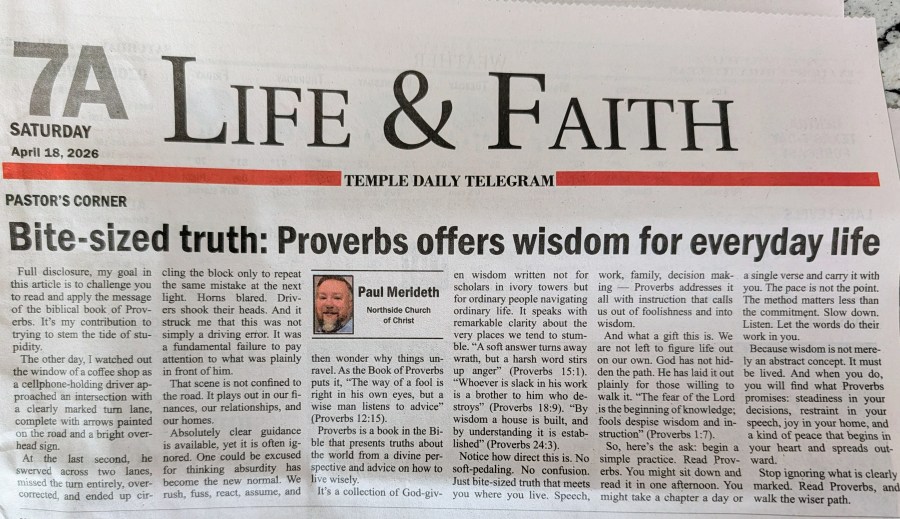
Full disclosure, my goal in this article is to challenge you to read and apply the message of the biblical book of Proverbs. It’s my contribution to trying to stem the tide of stupidity.
The other day, I watched out the window of a coffee shop as a cellphone-holding driver approached an intersection with a clearly marked turn lane, complete with arrows painted on the road and a bright overhead sign. At the last second, he swerved across two lanes, missed the turn entirely, overcorrected, and ended up circling the block only to repeat the same mistake at the next light. Horns blared. Drivers shook their heads. And it struck me that this was not simply a driving error. It was a fundamental failure to pay attention to what was plainly in front of him.
That scene is not confined to the road. It plays out in our finances, our relationships, and our homes. Absolutely clear guidance is available, yet it is often ignored. One could be excused for thinking absurdity has become the new normal. We rush, fuss, react, assume, and then wonder why things unravel. As the Book of Proverbs puts it, “The way of a fool is right in his own eyes, but a wise man listens to advice” (Proverbs 12:15).
Proverbs is a book in the Bible that presents truths about the world from a divine perspective and advice on how to live wisely. It’s a collection of God-given wisdom written not for scholars in ivory towers but for ordinary people navigating ordinary life. It speaks with remarkable clarity about the very places we tend to stumble. “A soft answer turns away wrath, but a harsh word stirs up anger” (Proverbs 15:1). “Whoever is slack in his work is a brother to him who destroys” (Proverbs 18:9). “By wisdom a house is built, and by understanding it is established” (Proverbs 24:3).
Notice how direct this is. No soft-pedaling. No confusion. Just bite-sized truth that meets you where you live. Speech, work, family, decision making. Proverbs addresses it all with instruction that calls us out of foolishness and into wisdom.
And what a gift this is. We are not left to figure life out on our own. God has not hidden the path. He has laid it out plainly for those willing to walk it. “The fear of the Lord is the beginning of knowledge; fools despise wisdom and instruction” (Proverbs 1:7).
So, here’s the ask: begin a simple practice. Read Proverbs. You might sit down and read it in one afternoon. You might take a chapter a day or a single verse and carry it with you. The pace is not the point. The method matters less than the commitment. Slow down. Listen. Let the words do their work in you.
Because wisdom is not merely an abstract concept. It must be lived. And when you do, you will find what Proverbs promises: steadiness in your decisions, restraint in your speech, joy in your home, and a kind of peace that begins in your heart and spreads outward. Stop ignoring what is clearly marked. Read Proverbs, and walk the wiser path.
Farmers live with a kind of holy uncertainty. They work hard, prepare the soil, plant the seed, and then step back into a mystery they cannot control. They cannot command the rain. They cannot hurry the sun. They cannot peer beneath the soil to see what is happening. They simply sow and trust that life will do what God designed it to do.
Those who share God’s Word live with the same uncertainty. You preach, teach, visit, listen, counsel, pray, study, and prepare. Yet there are seasons when the results seem hidden. A sermon is preached and the room looks unchanged. A conversation is had and the outcome is unclear. You scatter the Word, but you cannot see what is happening beneath the surface of a human heart.
Scripture reminds us that this uncertainty is not a flaw in the process. It is built into it. Paul wrote, “I planted, Apollos watered, but God gave the growth” (1 Corinthians 3:6). Ecclesiastes adds, “Sow your seed in the morning, and at evening withhold not your hand, for you do not know which will prosper” (Ecclesiastes 11:6).
Notice Jesus’ wording in Luke 8:11: “The seed is the word of God.” Not seeds. Seed. The life and power are already inside the message itself. The kingdom does not depend on the brilliance of the sower. God has already placed life inside His Word.
Which means the sower can relax his grip a little. The heavy lifting belongs to God.
Our mandate is simple. Keep sowing. Scatter the Word widely. Trust that somewhere, in some unseen place, God is already bringing life out of the soil.
A phone vibrates. An email arrives. A deadline shifts. A new “to-do” item shows up in the afternoon. Before long, the day is consumed by what is pressing. We move from notification to obligation to interruption, telling ourselves that if we can just clear the urgent, we will finally get to what is necessary. Yet the necessary rarely shouts. It waits quietly neglected while the urgent demands every ounce of attention.
This tension is not new. When Jesus visited the home of Martha and Mary, the house was full of activity. Martha was “distracted with much serving,” while Mary sat at the Lord’s feet (Luke 10:40–42). Jesus did not rebuke service. He gently named the deeper issue: “You are anxious and troubled about many things, but one thing is necessary.” The problem was not effort. It was misalignment. The urgent had eclipsed the necessary.
We live in a world that measures worth by output. Productivity becomes proof of value. Even rest is justified only if it makes us more efficient tomorrow. Without noticing, we begin to treat our own lives as projects to optimize. But Scripture tells a different story. God rested on the seventh day, setting a rhythm that declares we are more than what we produce (Genesis 2:2–3). The psalmist prays, “Teach us to number our days that we may get a heart of wisdom” (Psalm 90:12). Wisdom is not cramming more into our days, but discerning what belongs in them.
Jesus often withdrew to desolate places to pray (Luke 5:16). He was never ruled by urgency because he was anchored in communion with the Father. The necessary shaped his response to the urgent. The real work of discipleship is learning that same discernment. If Jesus structured his life around prayer, presence, and obedience instead of pressure and productivity, then we should follow his lead and do the same. Not clearing every notification, but choosing the better portion. Not becoming more productive, but more faithful.
Paul N. Merideth
Three nails forming a cross shape on a white background.
Some preachers are the kind of leaders who stride into a room, rally a team, draw a diagram on a whiteboard, and suddenly everyone is ready to charge the hill. Conversely, many ministers quietly wonder, “What hill are we charging, and can we talk about it over coffee instead?” The truth is not every leader is a visionary strategist. Some are teachers. Some are listeners. Some do their best work one conversation at a time. And that’s not a liability; it is a gift.
Paul Merideth
While strong vision-casting teambuilding leaders are a blessing to the church, not everyone can pull it off effectively. Thankfully, Scripture leaves plenty of room for men who lead in a low-key way. Paul tells Timothy to watch his life and teaching closely (1 Timothy 4:16). He tells the Thessalonians to encourage the fainthearted and help the weak (1 Thessalonians 5:14). Peter urges shepherds to lead “by example” rather than force (1 Peter 5:3). These passages sound far less like instructions for a corporate strategist and far more like the quiet, steady work of relational shepherding. Jesus himself shaped most of his leaders around tables, along roads, and in unhurried conversations. His most decisive leadership moments were rarely in committee meetings.
It took me a long time to realize that my gift in ministry was not being a dynamic, consensus-building, trend-setting leader. I could never stride into a room of elders and deacons and unveil a master plan for church goals over the next five years, with everyone walking out hyped up, shouting, “Let’s go!” And though I tried to be that tip-of-the-spear, dynamic, peak-performance, spiritual coach for many years, relief came only when I accepted that I was not that kind of leader. I am a teacher. I am a deliberate, reflective decision maker. I pray with people. I listen to their hurt. I talk to them about Jesus. I even believe slow is an acceptable speed.
And I am thankful God’s Word reminds us that this is enough. We each bring something different to the table. We each, “having gifts that differ according to the grace given to us, let us use them” (Romans 12:6). Paul is not asking us to become gifted in everything, only to steward well what God has actually placed in our hands. That truth frees ministers and elders alike from the pressure of imitation and invites us to simply live out the gifts God has entrusted to us.
When you stop trying to force a round peg into a square hole and accept that your gifts are not about being the grand motivator, you free yourself from pretending. You can stop trying to manufacture energy you do not naturally possess. Instead, you lean into your strengths. Relational leaders influence not through programs but through presence. Their leadership is felt in the way they listen, in the thoughtful questions they ask, and in the gentle guidance they offer when someone is hurting or confused.
This does not mean you abdicate leadership, far from it. It simply means your leadership moves in smaller circles that eventually ripple outward. When you invest in one elder, one ministry leader, or one team member, you help shape a person who will shape others. That is precisely how Jesus worked. The kingdom grows yeast-like, quietly spreading through ordinary interactions that never make an organizational chart but always leave a mark.
You do not have to build an ecclesiastical administrative machine to bless the church. You can bless it by being exactly who God made you to be. A teacher who steadies people. A shepherd who knows the flock by name. A presence that brings peace. A preacher who speaks the truth in love. Leadership is not always loud. Sometimes it sounds like a calm voice saying, “Let’s walk together.” And in the kingdom of God, that is more than enough.
During the holidays my movie watching skyrockets. I enjoy quality cinema, the kind with rich storytelling and thoughtful technique; think Jurassic Park, not Jurassic World Rebirth. And yes, the theater experience far exceeds the at-home one. My partiality for quality-only films and the theater experience prompts me to reflect on our worship as believers. Christian worship is not meant to be watched from a distance. It is an encounter, an embodied moment that draws us beyond observation into something richer and more transformative. True, genuine-quality worship is rooted in the incarnate Christ who entered our world in flesh and blood so that our whole selves could encounter him in meaningful ways.
Cinematic theory offers surprising parallels. Directors speak of qualia, the felt qualities of an experience that cannot be reduced to simple description. A sunset on screen is more than its colors, and a close-up of a trembling hand is more than pixels. Similarly, worship invites us to experience Christ’s presence. Singing, prayer, communion, and Scripture reading each carry their own spiritual qualia; stirring awe, conviction, gratitude, and hope in ways that surpass explanation. This echoes the psalmist’s invitation: “Taste and see that the Lord is good” (Psalm 34:8), a reminder that our faith engages the whole person.
Filmmakers also note how the eyes can become “an organ of touch,” especially in scenes marked by haptic perceptuality: moments when you don’t simply watch the story but feel it. The textures, nearness, and details create a sense of contact. Worship can work the same way. When we gather in Jesus’ name, we do not only look toward him as spectators. His presence touches us. Lifting our voices or receiving communion becomes a kind of spiritual tactile moment, a place where Christ meets us in real and embodied ways.
Another cinematic idea concerns the use of indexed and non-indexed camera angles. Sometimes the lens points directly at what the viewer must see. Other times it invites discovery through subtle or indirect cues. God uses both approaches. At times, the gospel feels unmistakably indexed: Jesus speaks clearly, Scripture convicts plainly, and we know exactly what he is asking of us. Other moments are quieter and non-indexed: gentle conviction, providential encounters, or unity with the Spirit. These understated moments reveal that Christ continues to guide those who recognize his voice. As Jesus profoundly says, “My sheep hear my voice, and I know them, and they follow me” (John 10:27).
Taken together, these images remind us that worship is an experience rather than a passive event. We think, feel, respond, and participate. We encounter Jesus not as viewers in the seats but as disciples fully engaged in the presence of the living Lord.
“The pride of your heart has deceived you… Though you soar aloft like the eagle… from there I will bring you down” (Obadiah 1:3-4). If you ever want a crash course in humility, meet the Edomites. These folks were so sure of themselves they basically built their homes in the sky and said, “Who’s gonna bring us down?” God’s answer was blunt: “I am.” Obadiah, the shortest book in the Old Testament, packs a mighty punch about pride and self-deception. They thought security was measured in stone walls and mountain heights, not in obedience and mercy. The Edomites felt invincible in their mountain stronghold of Petra, that rose-colored city carved into stone, but even walls of rock cannot protect a heart lifted up in pride from inevitable divine judgment. When their neighbors in Judah were attacked, Edom didn’t lend a hand. Instead, they pulled up a chair to watch the show. Thus God declares destructive judgment upon them because not only did they fail to render aid to brethren in distress, but they also kicked them while they were down. Pride had turned them cruel.
Pride still does that. It blinds us, convinces us we’re doing great, and then quietly hardens our hearts until compassion withers. God’s verdict on pride hasn’t changed: “God opposes the proud.” But here’s the good news: He still “gives grace to the humble” (James 4:6).
Obadiah’s lesson is simple… don’t build your house on the high cliffs of ego. Build it on the solid ground of Christ, the humble King. Pride crashes hard, but God always lifts the humble back up.
Paul N. Merideth
I am preaching through the Minor Prophets, those short books most folks skip over because they talk a lot about judgment. But here’s the surprise… behind every warning is a divine message about mercy and hope. God still invites His people back even when they have lost their way. Come join us Sundays at 10:30 a.m. at the Northside Church of Christ in Temple, Texas, as we dust off the words of these ancient prophets and discover how much they still have to say to us today.
Amor Towles has become my favorite modern historical fiction author. His style has a special charm, especially in his complex A Gentleman in Moscow. I am intrigued by the novel’s subtle theme on the role of possessions in our lives. The story tells of Count Rostov, once a man of mansions, reduced to a single attic room in the Metropol Hotel. As an ousted aristocrat, the Bolsheviks sentenced him to hotel incarceration. Stripped of most of his worldly possessions, he refuses to descend into despair and instead discovers that even the smallest possessions carry immense weight. A chair, a desk, or a well worn book becomes a doorway to memory. They anchor him to relationships, laughter, and beauty. Objects, for Rostov, evolve from trophies to be hoarded into vessels of story, grace, and continuity in a world turned upside down. As one myself who often sits at a desk, I love his observation: “A king fortifies himself with a castle,” noted the Count, “a gentleman with a desk.”
It makes me wonder, what do our possessions say about us? We often cling to them as if they grant us security, but Jesus warned otherwise: “Do not store up for yourselves treasures on earth… but store up treasures in heaven” (Matthew 6:19-20). Things break. Moths chew. Rust corrodes. Yet when received rightly, even the ordinary becomes extraordinary. A family Bible marked with fingerprints, a chipped mug from morning prayers, a beloved pencil used to journal, these are “Metropol moments,” everyday objects carrying spiritual meaning.
The same is true in the church. The wood of a pulpit, the worn pew where generations have prayed, or the baptismal waters, these are not sacred in themselves, but they bear witness to God’s grace at work in ordinary settings. Much like Rostov’s desk or books, they anchor us not to a fading past but to the eternal promise of God.
As the apostle Paul reminds us, “Godliness with contentment is great gain” (1 Timothy 6:6). In other words, hold things lightly, let them prompt blessed memories, but cling passionately only to the one treasure that cannot be lost. Towles shows us through fiction that even when stripped of much, life can still be full. The gospel goes further: “as sorrowful, yet always rejoicing; as poor, yet making many rich; as having nothing, yet possessing everything” (2 Corinthians 6:10). Our anchor is not a desk, a mug, or even a cherished family heirloom, but the Lord Himself. And unlike every object we can touch, He will never fade, rust, or be robbed away.