It’s summer in Texas, which we know not just because the calendar says so, but because the roads melt and traffic doubles. Vacation season is in full swing, and families are hitting the highways in search of rest, adventure, or maybe just a decent breeze.
We wish one another safe travels and good memories. We hope for rest from busy schedules, and we pray for peaceful, uneventful journeys (the best kind, really). But as we head out of town, let’s pack more than sunscreen and snacks; let’s also remember to bring our faith along.
There’s no “out of office” setting for Christian living. Colossians 3:4 reminds us that Christ “is” our life, not a compartment of it. So even if no one knows you at the beach or the outlet mall, you’re still known by God. That means our kindness, patience, and integrity should follow us to the check-in counter and through every TSA line.
Also, if Sunday rolls around while you’re away, find a local church. Your presence will encourage them, and your worship will honor God, the one who made your trip possible in the first place. Don’t take a vacation from what matters most.
We hope you enjoy your break, travel safely, and return refreshed. When you’re gone, you’re missed. When you’re back, we’re glad. God bless your summer.
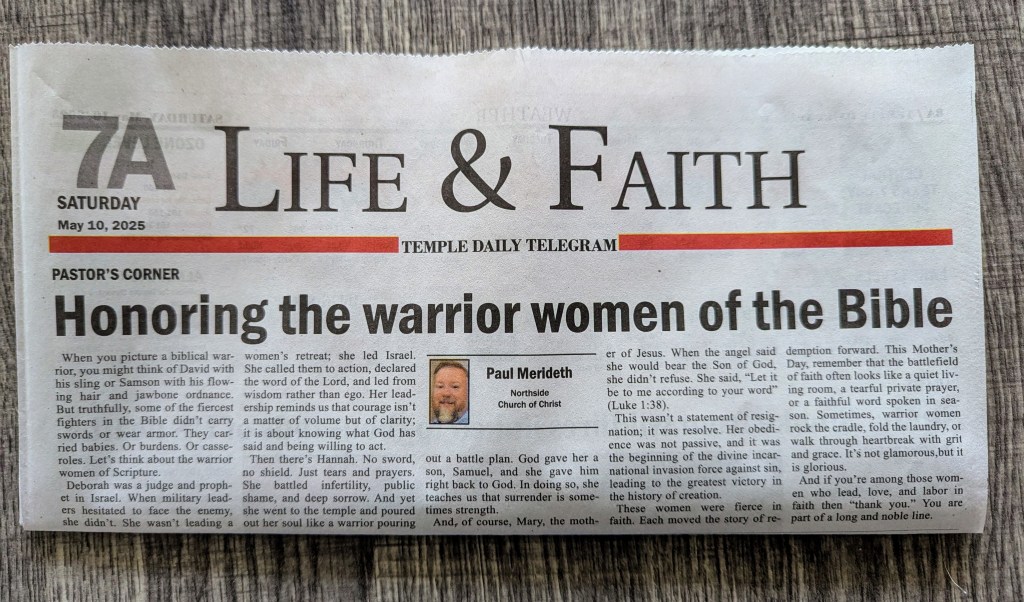
When you picture a biblical warrior, you might think of David with his sling or Samson with his flowing hair and jawbone ordnance. But truthfully, some of the fiercest fighters in the Bible didn’t carry swords or wear armor. They carried babies. Or burdens. Or casseroles. Let’s think about the warrior women of Scripture.
Deborah was a judge and prophet in Israel. When military leaders hesitated to face the enemy, she didn’t. She wasn’t leading a women’s retreat; she led Israel. She called them to action, declared the word of the Lord, and led from wisdom rather than ego. Her leadership reminds us that courage isn’t a matter of volume but of clarity; it is about knowing what God has said and being willing to act.
Then there’s Hannah. No sword, no shield. Just tears and prayers. She battled infertility, public shame, and deep sorrow. And yet she went to the temple and poured out her soul like a warrior pouring out a battle plan. God gave her a son, Samuel, and she gave him right back to God. In doing so, she teaches us that surrender is sometimes strength.
And, of course, Mary, the mother of Jesus. When the angel said she would bear the Son of God, she didn’t refuse. She said, “Let it be to me according to your word” (Luke 1:38). This wasn’t a statement of resignation; it was resolve. Her obedience was not passive, and it was the beginning of the divine incarnational invasion force against sin, leading to the greatest victory in the history of creation.
These women were fierce in faith. Each moved the story of redemption forward. This Mother’s Day, remember that the battlefield of faith often looks like a quiet living room, a tearful private prayer, or a faithful word spoken in season. Sometimes, warrior women rock the cradle, fold the laundry, or walk through heartbreak with grit and grace. It’s not glamorous, but it is glorious.
And if you’re among those women who lead, love, and labor in faith then “thank you.” You are part of a long and noble line.
Let’s start with the obvious: if you don’t have a pulse, you’re in trouble. No heartbeat? That’s not just bad news—it’s fatal. So what about the church’s pulse? If we pressed two fingers to her spiritual wrist, would we feel a strong, vibrant beat or a troubling stillness?
Paul Merideth
The church in Corinth, the one Paul wrote to, was showing some signs of spiritual arrhythmia. It was a congregation under siege, pressured by a surrounding pagan culture and infected by internal conflicts and divisions. Satan has always tried to convert the living body of Christ into a lifeless shell. And in Corinth, unfortunately, he was making headway.
But Paul didn’t write them off as spiritually dead. He didn’t rush in with condemnation or a clipboard to pronounce time of death. He opened his letter with something surprisingly hopeful: thanksgiving. That alone tells us the situation wasn’t terminal. There was life still beating in their chest.
He reminded them, “God is faithful, by whom you were called into the fellowship of his Son, Jesus Christ our Lord” (1 Corinthians 1:9).
There it is—the pulse. The steady rhythm that sustains the body of Christ. Faithfulness. Fellowship. These are not abstract theological ideas. They are the vital signs of Christian existence. They are not generated by our effort or enthusiasm but gifted to us by the One who gives life itself. We live because He is faithful. We thrive because we’ve been invited into a living, breathing, grace-filled connection with the Son.
So take a moment. Check your spiritual pulse. Is there a beat of gratitude in you? Can you sense the divine rhythm of grace pulsing through your spirit—God’s mercy, His provision, His redemption, His direction? These are not spiritual luxuries. They are signs of life. If they’re present, you’re alive. If they’re faint or missing, it might be time to consult the Great Physician.
And here’s the beautiful irony: even when our spiritual health falters, God remains steady. His faithfulness is not reactive. It doesn’t rise and fall with our performance. His grace does not ebb when ours does. It flows freely, relentlessly, keeping the body alive even when it stumbles.
Paul continues his note of thanksgiving with a cascade of affirmation: “I give thanks to my God always for you because of the grace of God that was given you in Christ Jesus…” (1 Corinthians 1:4-8). He goes on to describe how the Corinthians were enriched in every way—speech, knowledge, spiritual gifts—and not just enriched, but confirmed in their faith. They had what they needed to endure. And not only to endure, but to mature.
It’s important to remember that spiritual vitality is not measured by perfection but by direction. Are we moving toward Christ? Are we leaning into grace and growing in love? Is the pulse of our faith stronger today than it was yesterday?
In other words, the church wasn’t dead. She was bruised perhaps, confused at times, even spiritually reckless—but her heart was still beating. And Paul wanted them to hear that heartbeat loud and clear.
And yours is too, if you are in Christ. So take courage. Give thanks. God’s not done with you, and He’s not done with us. You and I are not sustained by sheer willpower. We are sustained by a faithful God who will hold us fast and bring us safely to the finish line.
As Paul says, He will sustain you to the end, guiltless in the day of our Lord Jesus Christ (1 Corinthians 1:8). That is not just a heartbeat. That is a promise. And that promise is pumping life into the church even now.
There are seasons in ministry and in life when we feel unseen. Not just unnoticed in passing, but overlooked in ways that cut deep. You show up, you serve, you carry burdens quietly, and yet decisions are made without you, tensions go unspoken, and your voice seems to vanish into the background.
Being unseen can feel like being unvalued. Over time, it wears on the soul.
But Scripture offers a steadying truth: We are seen by the God who sees.
Hagar, mistreated and alone in the wilderness, gave God a name no one else had: El Roithe God who sees me (Genesis 16:13). She wasn’t in a palace or a pulpit. She was a servant, a runaway, pregnant and hurting. Yet God saw her. He spoke to her. He called her by name.
When others overlook us, God does not. When leadership feels distant or cold, God is close. When our contributions go unnoticed, He keeps the record. Not for reward, but because that is who He is, the Shepherd who never loses track of a single sheep.
This does not always change our circumstances. But it can change our hearts. When we stop striving to be seen by people, we can rest in being known by God. And from that place, we can keep showing up, keep loving, keep serving, not for applause, but out of faithfulness.
If you’re in a season where your voice feels silenced or your presence seems to go unnoticed, take heart: You are seen. Not vaguely or generally, but specifically and tenderly by the One who matters most.
And in the quiet strength of that truth, you can keep going.
Psalm 147:3 declares, “He heals the brokenhearted and binds up their wounds.” This verse was written in the context of Israel’s restoration after exile, portraying God’s compassionate care for His people as He rebuilds their lives, heals their wounds, and restores their hope. This simple yet profound truth speaks to anyone who has ever felt the weight of sorrow. Heartache is not an abstract concept—it is real, personal, and often overwhelming. But the psalmist reminds us that God is not distant from our pain. He is a healer.
Notice the tenderness in this verse. God does not merely acknowledge our wounds; He binds them. This imagery evokes the care of a devoted nurse tending to a wounded patient—not rushing the process but gently and skillfully applying healing. In the same way, God is patient with our hurts, mending what feels irreparable.
Healing, however, is not always instant. The wounds of loss, disappointment, and regret take time. Yet the promise remains: God is at work, even when we cannot see it. Our brokenness is not the end of the story. In His hands, wounds become part of our renewal, and sorrow gives way to joy. Trust in His healing, one step at a time.
Have you ever tried to board a plane by running really fast beside it? Or maybe by standing underneath it admiring how powerful it looks? Perhaps you think you can make it home from your travels simply by studying the plane’s engineering without ever actually climbing aboard. Sounds ridiculous, right? None of these will get you home. The only way to reach the destination is to be IN the plane. When you’re in the plane, what happens to it happens to you. If it soars, you soar. If it lands safely, you land safely. Yet many people try to admire Jesus from a distance, hoping close proximity alone is enough.
2 Corinthians 5:17 tells us, “If anyone is in Christ, he is a new creation.” The only way to arrive at our eternal home is to be IN Christ. This isn’t just religious jargon—it’s the New Testament’s primary way of describing a Christian. Paul uses the phrase “in Christ” over 160 times. It’s arguably his favorite expression. More than simply admiring Jesus, being in Christ means being fully united with Him, embraced by His grace and transformed by His presence. What happens to Him happens to us. His death becomes our death to sin. His resurrection becomes our resurrection to new life. His standing before God becomes our standing. This is what it means to be in Christ.
So if you’re tired of trying to reach the destination on your own, maybe it’s time to stop running and get in Christ. Through faith, repentance, and baptism, His journey becomes yours and trust me, it’s first class all the way.
Paul Merideth
Current Sermon Series: Throughout the first quarter of 2025, I’m preaching a Sunday series called In Christ. You’re invited to join us each Sunday at 10:30am as we explore what it truly means to live out our identity in Him. Come connect, grow, and walk in the fullness of life in Christ—I’d love to see you there! northsidetemple.org
Book Recommendation: Consider checking out this new book by Sam Allberry from Crossway. As I’ve worked on this lesson series, I’ve found it insightful and encouraging. It explores the life-changing reality of being in Christ.
The desire of a faithful church is to see every member fully equipped to serve in God’s kingdom. In Ephesians 4:11-16, the Apostle Paul provides a compelling picture of what this looks like: a body “joined and held together by every joint with which it is equipped, when each part is working properly, makes the body grow so that it builds itself up in love” (v. 16). This vision is not one of passive participation but of purposeful engagement, where each member contributes to the upbuilding of the whole. A thriving church is alive and active, filled with individuals committed to serving God and one another.
Paul Merideth
David’s encounter with Goliath offers a powerful example of being equipped for God’s work. When he faced the giant, David did not go empty-handed or rely on tools that didn’t suit him. Instead, he used the resources and skills unique to him—a sling, five stones, and an unshakable trust in God. Armed with these, he overcame a seemingly insurmountable challenge. In the same way, God equips every believer with unique talents, tools, and opportunities perfectly suited to their mission.
Scripture reminds us repeatedly that our strength and readiness come from God. The psalmist declares that it is God who equips us with strength (Psalm 18:32), and Paul writes that Scripture makes us “competent, equipped for every good work” (2 Timothy 3:17). These truths empower us to step boldly into the tasks God has prepared, confident that He provides everything we need to succeed.
A church that embraces this vision becomes a place of unity, zeal, and maturity. Unity comes when every resource and talent is dedicated to God’s glory, fostering a sense of shared purpose and collaboration. Zeal is evident when members are eager and enthusiastic about participating in the life and mission of the church. Maturity develops as individuals grow in faith, enabling the church to carry out its ministry with wisdom and effectiveness.
When every member takes up the call to be equipped for service, the church flourishes. It becomes a community that builds itself up in love, deeply engaged in fulfilling God’s mission in the world. This is not merely an aspiration but a call to action. Each believer is urged to pray for God’s guidance and strength, to seek opportunities for growth, and to contribute actively to the life of the church.
The writer of Hebrews offers a fitting prayer: “Now may the God of peace… equip you with everything good that you may do his will, working in us that which is pleasing in his sight” (Hebrews 13:20-21). May this prayer shape and inspire all who seek to be equipped for every good work, faithfully building one another up and carrying out God’s will.
Bible Reading Plan
Reading through the entire Bible in a year can be a challenge for many. Why not try a two-year plan instead? Over 2025 and 2026, journey through the entire Bible at a steady pace. This plan includes readings on weekdays only, leaving weekends open for catching up or deeper study. You can access the reading plan HERE.
I am not a Grinch. I love Christmastime—it’s my favorite season of the year. In fact, I enjoy The Polar Express and its heartwarming message. All those TV holiday specials are great family fun. But I do have a complaint, and it’s about one word we see plastered everywhere this time of year: “Believe.”
You’ve seen it on ornaments, holiday cards, and even glowing in front-yard light displays. BELIEVE! It’s everywhere. Don’t get me wrong; I love the word. But I think we should handle it with a little more care.
Paul Merideth
As a Christian minister, I’m concerned that “believe” has been diluted into a vague sentiment. It’s become a shallow slogan afflicted with the Hallmarkification effect, stripped of its profound meaning and tethered to little more than seasonal cheer. We’ve orphaned the word from its theological context and expect it to carry, all naked and alone, the entire weight of our holiday hopes.
The truth is the word believe carries immense significance in the Christian faith. It is central to who we are as God’s people. And while I don’t begrudge Santa his sleigh, I must insist that “believe” belongs to something infinitely greater. So, I propose we reclaim it and carefully put it back in its nest with the rest of sacred vernacular.
Here’s why this is important. We don’t merely “believe” in an undefined ethereal spirit of winter tidings or a vague sense of holiday magic. No, we believe in God, the Father Almighty, Creator of heaven and earth. We believe in Jesus Christ, His only Son, our Lord—who was conceived by the Holy Spirit, born of the virgin Mary, suffered for our sins at his crucifixion, died, and was buried. On the third day, He rose again. He ascended to heaven and is seated at the Father’s right hand. He will come again to judge the living and the dead. This is what we believe.
“Believe” isn’t just a word to dangle in twinkling lights or print on a mug. It’s not to be etched alone without its divine object clarified. Indeed, the object of our belief is God. It’s a cherished faith conviction that connects us to the God of the universe. Jesus Himself said, “Let not your hearts be troubled. Believe in God; believe also in me” (John 14:1). And Paul reminds us, “If you confess with your mouth that Jesus is Lord and believe in your heart that God raised him from the dead, you will be saved” (Romans 10:9).
This Christmas, let’s reclaim the depth of what it means to believe. As we enjoy the holiday lights and festivities, let’s reflect on the One who gives us hope, joy, and peace—not just for a season, but for eternity. May your Christmas be filled with love, generosity, and the light of Christ. Whether through acts of kindness, a shared smile, or a helping hand, let’s each embody the good news of Jesus this season. I wish you all a Merry Christmas and pray for the Lord’s continued favor upon us all. After all, I believe in our good and gracious God.
This article was published in the Temple Daily Telegram‘s “Life & Faith” section on Saturday, December 21, 2024. Check it out on their website HERE.
Thanksgiving is more than turkey and pie—it’s a divine nudge to look beyond the mashed potatoes and into the heart of God’s goodness. As Paul reminds us in 1 Thessalonians 5:16-18, “Rejoice always, pray without ceasing, give thanks in all circumstances; for this is the will of God in Christ Jesus for you.” That’s not just a seasonal sentiment—it’s a life-altering perspective.
Take a moment to reflect on Luke 17, where ten lepers were miraculously healed by Jesus. Ten received the gift, but only one paused, turned around, and fell at Jesus’ feet with thanks. What made him different? Gratitude. Not the casual, “Thanks, Jesus, gotta run!” kind, but a deep, soul-level recognition of the Giver behind the gift.
True gratitude transforms how we see everything. It’s not just about counting blessings but recognizing the One who blesses. It shifts our focus from fleeting circumstances to God’s unchanging goodness. It strengthens our faith, especially in life’s tougher seasons, and allows us to see His grace in ways we might otherwise miss.
So this Thanksgiving, as you savor the stuffing and argue over who gets the last slice of pie, let your heart overflow with thanks—not just for what you have but for who He is. May your gratitude echo the words of that healed leper, glorifying God with every ounce of joy and praise.
Happy Thanksgiving to you and your family—may it be a season full of grace, gratitude, and maybe a second helping of your favorite dessert.
In today’s world, “self-care” often evokes images of spa days, digital detoxes, and naps. While Jesus’ ministry was filled with intense demands and self-sacrifice, we see clear examples of how He cared for His own soul in ways that are strikingly relatable. His “self-care” practices included prayer, setting boundaries, and spending time with friends over meals.
First, prayer was central to Jesus’ life. Luke 5:16 notes, “But he would withdraw to desolate places and pray.” Despite the constant needs around Him, Jesus often took time alone with the Father, seeking rest, strength, and guidance. This wasn’t an occasional retreat; it was a regular rhythm in His life.
Jesus also demonstrated the importance of saying “no.” When the disciples urged Him to continue performing miracles in Capernaum, He replied, “I must preach the good news of the kingdom of God to the other towns as well; for I was sent for this purpose” (Luke 4:43). By setting boundaries, He showed that being faithful to His mission sometimes required stepping away from immediate expectations.
Finally, Jesus valued friendship and community, often gathering with His disciples over meals. Whether He was at a wedding in Cana, reclining at the table with Mary and Martha, or sharing the Last Supper, Jesus used these moments to strengthen His relationships and teach His followers. Matthew 11:19 says, “The Son of Man came eating and drinking,” showing His delight in the fellowship of friends.
While Jesus’ life was undoubtedly unique, His practices offer wisdom for us today: seek God in prayer, know your purpose, and cherish meaningful relationships.