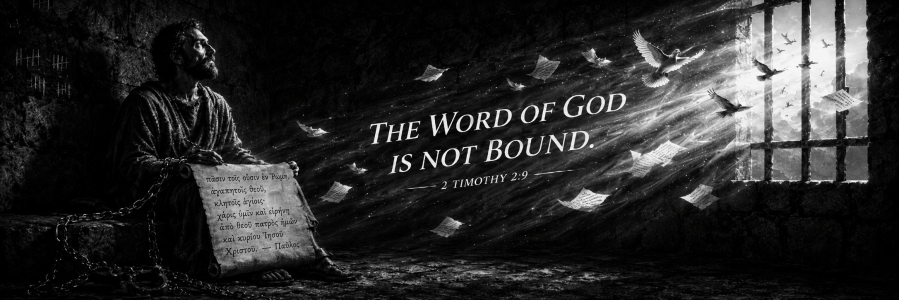
Faith like Paul’s does not deny the chains; it simply believes the gospel is still free.
Paul knew the cold weight of iron, the humiliation of confinement, and the uncertainty of waiting under Roman power. He did not romanticize suffering or pretend that hardship was painless. He felt the chains. He heard the doors lock. Yet from within those limitations, he declared, “I am suffering, bound with chains as a criminal. But the word of God is not bound!” (2 Timothy 2:9).
That is the defiance of Christian faith.
Faith does not require us to call darkness light. It does not ask us to deny the diagnosis, ignore the grief, minimize the opposition, or pretend the prison is not real. Faith looks directly at the chain and then looks beyond it to the sovereign God whom no chain can hold.
Paul’s imprisonment appeared to be the end of his usefulness. Instead, it became another pulpit. Guards heard the gospel. Churches received letters. Believers became bolder. What seemed like restriction became advancement. “What has happened to me,” Paul wrote, “has really served to advance the gospel” (Philippians 1:12).
We often assume God can use us only when circumstances are favorable, doors are open, and burdens are lifted. Paul teaches us otherwise. God may do some of His deepest work through the very limitation we keep asking Him to remove.
Your chains may be real, but they are not sovereign. Your circumstances may restrict your movement, but they cannot imprison God’s purpose. The gospel is still free—and through faithful people, it is still moving.
Paul Merideth
 Christian Light